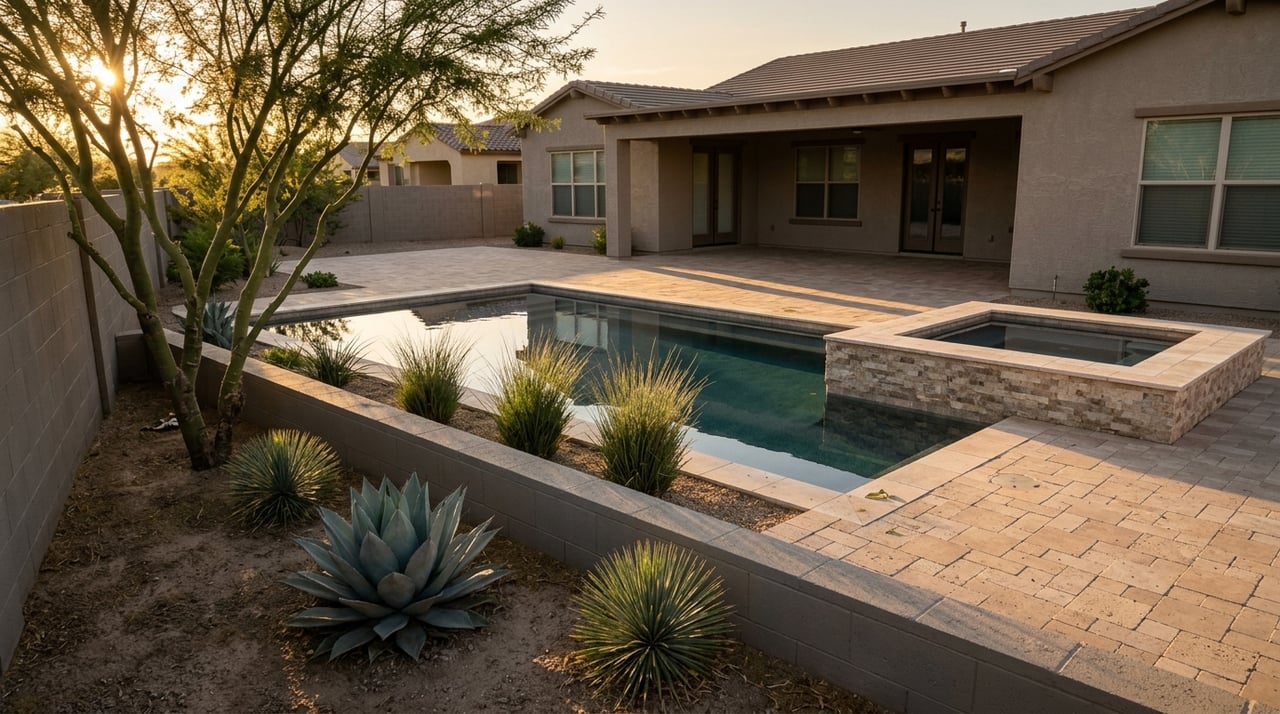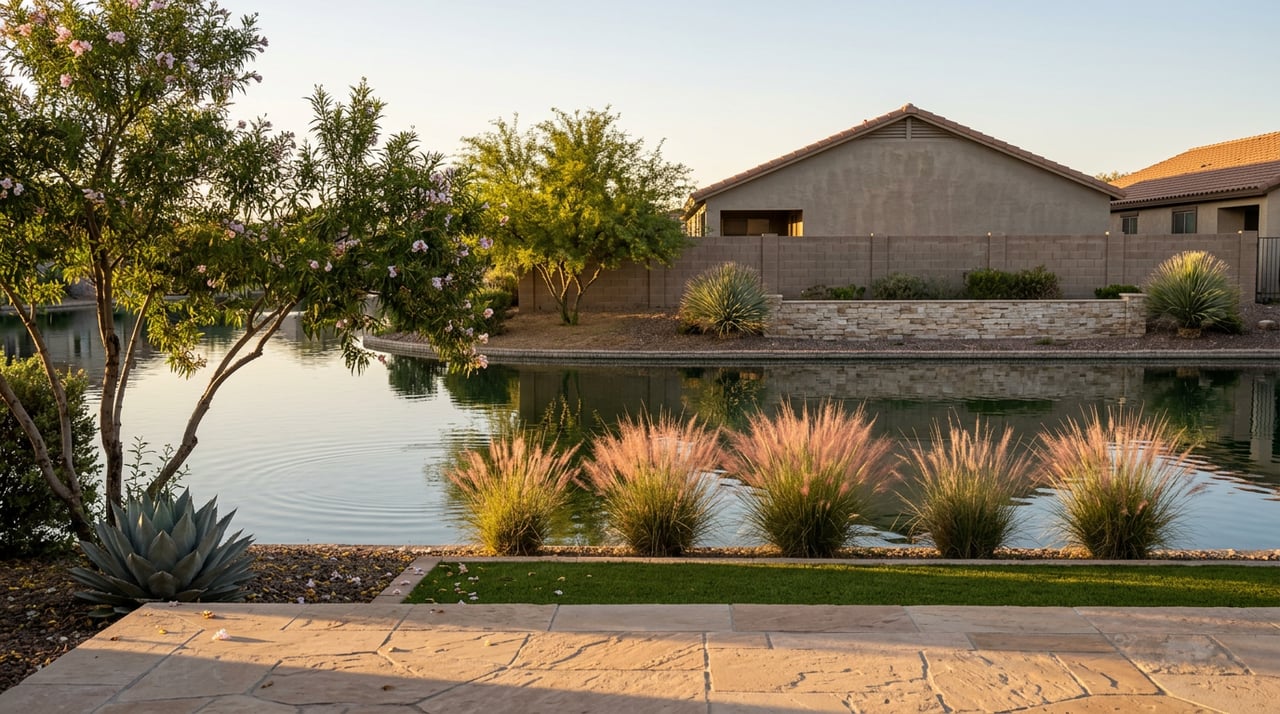
"It smells like they are starting to rot," one Ocotillo resident told a local news crew, describing the week her neighborhood lake turned into a floating fish graveyard. Another neighbor put it more bluntly: it smelled like thousands of rotting fish, because that is exactly what it was.
If you have lived in or around Ocotillo for more than one winter, you have probably smelled this before. Every year, without much warning, the water along Queen Creek and Price roads starts giving up its tilapia. Grandkids visit and someone quietly suggests a different walking route. Then, a week or two later, it is gone, and the lake is back to looking like the postcard version of itself.
Almost nobody who lives here has ever been told what is actually going on beneath the surface. It is not neglect, and it is not pollution. It is a 40-year-old engineering system doing exactly what it was built to do, and the smell is one of its side effects.
A Golf Course Sitting on 162 Acres of Reused Water
Ocotillo was built in 1986 around an idea that was unusual for the desert at the time: instead of drawing on groundwater to keep a master-planned community green, developers designed a closed loop that runs on effluent, meaning water that has already been used and treated by the City of Chandler's water reclamation system. That water gets pumped through the community's lakes, used again to irrigate the golf course and common areas, and cycled back through the system rather than pulled fresh from the ground.
The scale of that loop is bigger than most residents realize. The Ocotillo Community Association's own numbers put the lake system at 162 acres of interconnected water and more than 23 miles of shoreline, moved by a network of roughly 15 pumping stations that keep water circulating from lake to lake and out to the irrigated common areas. That makes Ocotillo one of the largest reclaimed-water users of its kind in the region, not because anyone marketed it that way, but because keeping a desert golf community this green without groundwater required building infrastructure most neighborhoods never think about.
The lakes are not just a residential amenity, either. The Ocotillo Community Association's boundaries stretch across the golf resort, apartments, offices, and retail, not just the houses with water views. When you walk a stretch of shoreline near Cantabria Shores or Monterey Bay, you are walking past a piece of municipal water infrastructure that happens to have ducks on it.
The Fish Are Not Pets. They Have Jobs.
The other thing most people miss is that nothing living in these lakes got there by accident. The association stocks specific species for specific reasons, and each one is doing a task rather than just occupying space.
- Tilapia and grass carp eat algae, which keeps the water from turning green and choking on itself.
- Catfish clean up dead fish and other debris, which is part of why they are also popular with anglers.
- Goldfish help keep mosquito populations down.
- Bluegill and smallmouth bass round out the ecosystem and give the lakes a self-sustaining food chain.
Grass carp get particular attention because of how fast they reproduce. Arizona requires this species to be genetically sterilized before stocking, specifically so a few carp released decades ago do not turn into an uncontrollable population that overwhelms the lake and canal system. It is one of the few places where a state regulation exists purely to stop a fish from doing too well at its job.
Why the Lake Empties Its Stomach Every Winter
This is where the smell comes back in. Tilapia are a warm-water species, and the Ocotillo Community Association's own lake page notes that tilapia tend to die off once the ambient water temperature drops below about 70 degrees Fahrenheit, typically sometime between mid-December and February. When a cold snap hits, tilapia die in large numbers, sink, and then resurface days later as they bloat with gas, which is what creates the smell that lingers for a week or two every winter.
Arizona Game and Fish has confirmed the broader pattern publicly, telling local reporters that die-offs like this are considered normal whenever water temperatures fall enough to stress a warm-water species, and that it happens most winters somewhere in the Valley, not just at Ocotillo. What surprised a lot of residents during one particularly bad die-off was learning that the association had not restocked tilapia in over a decade. The fish that survive each winter simply reproduce fast enough to repopulate the lakes on their own, which means the population the neighborhood sees every January is not new stock brought in by a truck. It is the descendants of fish that have been living and dying in these same lakes for years.
None of this means the water is unsafe. Officials have been clear that other fish species in the same lakes remain safe to catch and eat. The die-off is specific to tilapia and specific to cold snaps, and crews typically spend days pulling dead fish out of the water until the cycle finishes on its own.
What the Rest of the Year Actually Looks Like
The other 46 or so weeks of the year, this same infrastructure is why Ocotillo looks the way it does. The lakes support a surprising range of birds, from small black coots to great blue herons, along with regular visits from ducks, geese, sandpipers, terns, and the occasional pelican passing through. None of that happens without the fish and the aeration fountains working underneath the surface to keep oxygen levels up.
It is also why Ocotillo Golf Club, designed by architect Ted Robinson and opened the same year as the community itself, plays so differently from the desert courses that surround most of the Valley. Water comes into play on nearly every hole across its three nine-hole courses, and the patio at Tillo's Kitchen and Patio has become one of the more reliable sunset spots in Chandler precisely because it sits over cascading water rather than gravel and rock.
What This Actually Means If You Live Here
None of this is really about real estate. It is about understanding a piece of infrastructure you interact with every time you walk the dog, take a call outside, or drive past a lake on your way to Alma School Road. The lakes are not scenery that happened to come with your neighborhood. They are the visible part of a water reuse system that predates almost everyone currently living around it, and the smell every January is one of the few times that system tells on itself.
It also explains why the association is protective about anything that touches the shoreline or the common areas around it. Exterior changes near the water go through review not because of aesthetics alone, but because the lakes are functioning equipment, not landscaping.
Next time someone new to the neighborhood asks what is wrong with the lake in January, you will have an actual answer instead of a shrug.
If you are the kind of person who wants this same level of detail about a different corner of Chandler, or about Gilbert, Queen Creek, or Casa Grande, that is the kind of local reporting REBL AZ Properties keeps digging into. We are not going anywhere, and neither is the smell every January, so feel free to reach out whenever a bigger question about your neighborhood comes up.